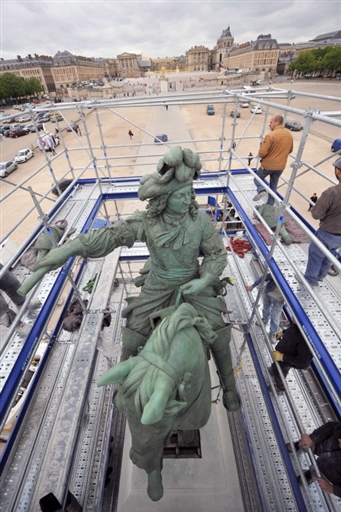
Philippe Herve cringed at the sight of Asclepios, the Greek god of medicine, covered in grime in the magnificent gardens of the Chateau de Versailles and decided he could help.
VERSAILLES - A history buff and physician, Herve joined the legions of private donors taking part in the palace's "Adopt-a-Statue" programme to raise funds for restoration work at the 17th-century home of Louis XIV, the Sun King.
"We just couldn't let Asclepios stand there covered in moss," said Herve jokingly about his decision. "He's the god of medicine and I figured I had to choose him."
For the past four years, Versailles' directors have been seeking out generous patrons willing to part with 3,000 to 30,000 euros (4,200 to 42,000 dollars) to help restore one of the works on the majestic property.
Two million euros in private donations have been raised so far, giving 86 statues and vases a new lease on life at Versailles, one of France's most visited tourist sites.
After just a few months of work, Asclepios has lost his greyish complexion and was returned to his prime spot near the Grand Trianon, the king's garden retreat.
"He looks magnificent," beamed Herve. "He stands proud with an intelligent gaze... I'm very pleased."
A world heritage site on the western fringe of Paris, the Chateau de Versailles launched a vast, 20-year restoration programme in 2003 that draws heavily on high-profile sponsorship from private companies and individuals.
Major restoration works completed so far include the Petit Trianon, Marie Antoinette's pastoral hideaway on the palace grounds, the royal gate torn down during the French Revolution and the Hall of Mirrors.
Versailles' directors had a successful first experience with public funding appeals in 1999 after a severe storm uprooted thousands of trees, many of which were rare species.
With the "Adopt-a-Tree" scheme, 10,000 new trees were planted through private donations of 150 euros each.
Last month, the "Adopt-a-Bench" scheme was announced to restore the grounds' 170 benches, some of which feature intricate works of carved stone and marble.
Sponsors are asked to donate 3,800 euros (5,300 dollars) in exchange for a small plaque bearing their name at the foot of the bench.
With her contribution, Paris area lawyer Catherine Posokhow allowed a statue of Apollo languishing near the Mirror Pool to recover a finger and part of its cape.
A small plaque in recognition of her generosity has been laid at Apollo's feet.
"Of course it's rewarding," said Posokhow of her gesture.
Part of the attraction of funding restoration work for her was the tax break as 66 percent of her donation was tax-deductible.
"I have to pay taxes and this way, I know where my money is going," she said.
Posokhow said the fund-raising programmes were not drawing just wealthy patrons and that many works are being restored through a collection of smaller 150-euro donations given to the Friends of Versailles support group.
"It's for all sizes of pocketbooks," she said.
More than three million tourists visit Versailles each year, admiring room-after-room of fine chandeliers, priceless frescoes and gold leaf adornments.
Louis XIII used Versailles as a hunting lodge long before his son expanded it in the late 17th century, moving the court and government of France there in 1682.
AFP/Expatica
Source
Private donors help Versailles recover its splendour


Outside Lands Best Bets: Wired’s Guide to Kick-Ass Bands at This Weekend’s Music Fest
By Nick Bowden August 27, 2009
Deciding which bands to see at multiple-stage festivals with more than 60 acts to choose from can be overwhelming to the unprepared. Good thing Wired’s got your back. We’ve done the prep work and selected the 10 must-see up-and-coming artists at this year’s Outside Lands Music and Arts Festival in San Francisco.
The three-day event, which takes place in the wooded environs of Golden Gate Park, starts Friday afternoon and runs through Sunday night.
At big festivals, bands often start late and run past their scheduled slots, and all the artists you want to see are rarely on the same stage. So, we’ve included some other killer acts performing before and after each of our picks on the same stage or nearby. As one show winds down, you’ll have enough time and know-how to refresh yourself, grab some food and a frosty brew before charging to the next musical encounter. The Outside Lands online schedule lets you create your own festival itinerary.
Now, to our picks!
Friday
Akron/Family: Friday 1:45-2:30 (Lindley Meadow)
The psychedelic folk of Akron/Family translates well to live performances. Known to invite fans to join them in chanting parades off-stage, so who knows where you’ll end up? (Read our Akron/Family spotlight.)
Before: West Indian Girl (Speeway Meadow 1:00-1:45)
After: Zee Avi (Speedway Meadow 3:20-4:00)
Zee Avi: Friday 3:20-4:00 (Speedway Meadow)
A key strategy in music festivals is finding the perfect mellow act to serve as a buffer between heavy, head-bangin’ bands. Zee Avi provides a great interlude to all the rockin’ with her dulcet guitar and folky, soulful ballads. Standing a skosh over 60 inches, it’s a spectacle just to watch so much soul come from such a tiny being. (Read our Zee Avi spotlight.)
Before: Akron Family (Lindley Meadow 1:45-2:30)
After: Blind Pilot (Lindley Meadow 4:10-4:55)
Blind Pilot: Friday 4:10-4:55 (Lindley Meadow)
Led by the interplay between singer Israel Nebeker and drummer Ryan Dobrowski, this six-piece ensemble takes indie folk past its mellow norm, past folk-rock storytelling, straight to singing and dancing scream-a-longs.
Before: Zee Avi (Lindley Meadow 3:20-4:00)
After: Black Joe Lewis & The Honeybears (Lindley Meadow 5:05-5:45)
Black Joe Lewis and The Honeybears: Friday 5:05-5:45 (Speedway Meadow)
If you took Little Richard’s finger and stuck it into a light socket, you might reach the intensity of funk that is Black Joe Lewis and the Honeybears. With a nine-piece ensemble and their own genre of music — “Garage Soul” — be ready to shake your moneymaker and get down to funky town.
Before: Blind Pilot (Speedway Meadow 4:10-4:55)
After: Q-Tip (Speedway Meadow 5:50-6:50)
Q-Tip: Friday 5:50-6:50 (Speedway Meadow)
He tours with a live jazz band that sets the stage for the emcee’s tomfoolery. As a singer, rapper and music composer, there are few people more full of life on stage than this Queens-bred artist. Also, he’s just a cool guy to spend an hour with.
Before: Black Joe Lewis and the Honeybears (Speedway Meadow 5:05-5:45)
After: Thievery Corporation (Speedway Meadow 7:40- 9:00)
Saturday
Groundation: Saturday 2:20-3:05 (Lindley Meadow)
Roots reggae combo Groundation packs a righteous punch with a full band, horn section and plenty of Jah spirit to keep you dancing and singing for the whole set. Plus, they’re Bay Area locals and they have a new record, Here I Am to celebrate.
Before: Zion I (Polo Field 12:30-1:20)
After: Portugal. The Man (Speedway Meadow 3:10- 3:50)
Portugal. The Man: Saturday 3:10-3:50 (Speedway Meadow)
Intense roots-rock jams overlayed with singer John Baldwin Gourley’s epic vocals inspires one kick-ass spectacle. Their last album, The Satanic Satanist is an unabashedly pop-centric album that will have you singing in stride (though probably not in tune — how does he hit those high notes?) with this unique ensemble. (Read our Portugal. The Man spotlight.)
Before: Groundation (Lindley Meadow 2:20-3:05)
After: Trombone Shorty and Orleans Ave (Lindley Meadow 4:00–4:45)
Dengue Fever: Saturday 3:10-4:00 (Lindley Meadow)
A truly novel act, Dengue Fever combines surf-inspired psychedelic rock with traditional Cambodian pop sounds of the 1970s. They pair classic covers with original tunes — mostly sung in vocalist Chhom Nimol’s native Khmer — and they’re guaranteed to provide an experience unlike any of the other bands at Outside Lands.
Before: Groundation (Lindley Meadow 2:20-3:05)
After: TV On The Radio (Speedway Meadow 5:40-6:40)
Deerhunter: Saturday: 6:40-7:25 (Speedway Meadow)
The off-kilter, ear-shredding guitar noise freakout of a typical Deerhunter set is a nuanced indie experience. Led by the mellow drama of lead singer Bradford Cox’s gauzy vocals, the show is all set to inspire and entertain in the most lysergic of modes.
Before: TV on The Radio (Speedway Meadow 5:40-6:40)
After: The Mars Volta (Speedway Meadow 7:30-9:00)
Sunday
The Dead Weather: Sunday 3:50-4:50 (Speedway Meadow)
When rock stars branch out from their own popular acts to form a new ensemble, the result is a must-see. The Dead Weather is composed of successful artists from various acts, such as The White Stripes, The Racontuers, Queens of the Stone Age and The Kills. The centerpiece is Jack White, guitarist for the White Stripes, who also takes turns on drums in The Dead Weather. His guitar skills are currently on full display in the new rockumentary, It Might Get Loud, but just imagine what he’ll do when the cameras aren’t rolling.
Source

Big weekend for Eat Real in Oakland
Tara Duggan, Chronicle Staff Writer
Thursday, August 27, 2009
From street fairs to food-and-wine galas, the Bay Area is home to a wide range of food-oriented celebrations. But Anya Fernald, executive director of last year's Slow Food Nation, wanted to find the middle ground between events like the county fair, where everything is fried on a stick, and chef-heavy ticketed affairs.
Last September, when Fernald resigned from Slow Food Nation after wrapping up the event, she got to thinking about a new food festival concept. She saw so much interest in the traditional cooking methods and sustainable food that were celebrated at Slow Food Nation, but she also saw the potential to reach a larger audience.
"How can we take the values of good food and make it universally accessible?" she wondered.
The result, Eat Real, premieres Friday at Jack London Square and continues through Sunday. Whereas the tasting hall at Slow Food Nation cost $65, Eat Real is a free outdoor street food event. Forty vendors - from Phatt Matt's BBQ to the cult favorite creme brulee cart - will offer small bites costing around $5 and less, using sustainable ingredients as much as possible.
"Street food is a universal language," said Fernald, who teamed up with several colleagues from Slow Food Nation to organize Eat Real. "It crosses barriers and includes all kinds of cultures."
Oakland pushcart vendor Cecilia Lopez will sell her fresh fruits, in the Mexican street cart tradition, while Zella's Soulful Kitchen will offer Southern fare. Pizza Politana will serve slices of wood-fired pizza baked in the trailer oven, utilizing local ingredients.
"It's fun," said Politana co-owner Joel Baecker, a former chef whose company now has stands at eight Bay Area farmers' markets. "People can come right up to you and ask questions, as opposed to at the restaurant, where you're kind of removed."
A separate market will feature 40 local farmers and artisans, but not all of the prepared food will be organic, in order to keep prices between $1 and $5. To help keep the event sustainable, festival organizers are helping vendors who don't normally use free-range and hormone-free meat secure a supply for the festival.
The festival will forgo wine for a more populist beer shed, with 20 microbreweries housed in a converted shipping container. It will also feature free performances and cooking demonstrations throughout the day, including for kids, and outdoor movies at night.
Special events will show off some of the more artisanal and offbeat sides of Bay Area food culture. At Ice Cream Friday, 10 Bay Area gelato, sorbet and ice cream makers will offer tastings from 4 to 8 p.m. Homesteading types are invited to a foraging and canning exchange and contest at 6 p.m. Friday. At 7 p.m. Saturday, another contest will pit three teams of butchers against one another to break down a quarter steer.
Food-related bike tours of Oakland are being offered by the East Bay Bicycle Coalition, and fan's of Novella Carpenter's new memoir, "Farm City" (Penguin Press HC), can tour her urban vegetable and livestock farm in the heart of the city.
Eat Real organizers are expecting 25,000 people to attend the event. In light of the high turnout, which led to overcrowding at last weekend's sister event, the San Francisco Street Food Festival, organizers say Eat Real will be physically more spread out, with more vendors, and will have more line control.
The goal, said Fernald, is to spread the message that good food can be affordable and accessible. It doesn't hurt that street food has gotten incredibly trendy in the past year.
"There are lots of ways to get people excited about food," said Fernald. "Restaurant tastings and wine tastings - that's one way. But to me, street food is the Rosetta stone."
Inside: Reviews of Tataki in San Francisco and Santi in Geyserville, and restaurant news in Inside Scoop. E2-3
Coming Sunday: Five Bay Area chefs share tips and recipes for outdoor entertaining. Food & Wine.
Eat Real Festival, Jack London Market, Jack London Square (at Embarcadero and Webster), Oakland. 4-9 p.m. Friday, 10 a.m.-9 p.m. Saturday, 10 a.m.-5 p.m. Sunday. Tickets for the beer shed can be purchased in advance, at $20 for eight tastes ($25 at the door). Cash only (credit cards accepted at beer shed). See eatrealfest.com for times, tickets and locations of special events.
Source

Russia and Mongolia closer
A successful visit by President Dmitry Medvedev to Mongolia has resulted in numerous agreements, settling a debt issue and launching social and economic development projects in various areas. A strategic partnership has effectively been launched.
The agreements signed by Presidents Dmitry Medvedev and Tsakhiagiyn Elbegdorzh today in the capital city of Mongolia, Ulan Bator, constitute a strategic partnership being the two countries closer together than at any time since the voluntary dissolution of the Soviet Union (as predicted and catered for under Soviet Law).
Both countries have agreed to set up a joint venture to develop the uranium fields of Dornod in north-east Mongolia and another agreement saw Ulan Bator railways handing over 50 per cent of their stock for the Russian Railways Company to manage. Both parts also declared the will to solve a 150 million-dollar debt question left over from Soviet times as soon as possible.
Both leaders expressed their satisfaction at the new climate of bilateral cooperation, stressing the good prospects for a fruitful future in their joint press conference in Ulan Bator after signing a declaration of strategic partnership.
Among the agreements in the area of cultural ties, Russia agreed to invest more in developing the Russian language in Mongolia.
Timofei BYELO
Source

Teen youngest to sail solo around world
Aug 27, 2009 10:02 AM - THE ASSOCIATED PRESS

LONDON–A 17-year-old British sailor became the youngest person to sail around the world without assistance on Thursday, completing the solo trip in nine months.
Mike Perham grabbed the solo record after completing the 28,000-mile (45,000-kilometer) trip, crossing the finish line in Cornwall, in southern England. He is now sailing to Portsmouth for a celebration on Saturday.
During the grueling journey, Perham said he tackled 50 foot (15 meter) waves, gale force winds and technical problems.
"It's definitely the hardest part of the trip being on your own because there is no one there to help you, and you do miss the physical contact," he told the BBC.
Perham's team said he finished the trip in a 50-foot (15-meter) racing yacht Totallymoney.com at approximately 9.55 a.m. The teen set off in November 2008.
Perham is a few months younger than Zac Sunderland, a 17 year old from Thousand Oaks, California, who had grabbed the youngest solo crown in July when he completed a similar trip in 13 months.
To mark Thursday's achievement, the Guinness Book of World Records created a new category for Perham – youngest sailor to circumnavigate the globe solo, supported.
His father, Peter, sailed in a boat behind him, but did not offer assistance – which Guinness defines as being accompanied on the boat by another human being, said Amarilis Espinoza, a spokeswoman for the record book.
"I've made it, I've made my dream come true, and it feels amazing," the teen said. "A big, big thanks to my dad, mum, all the sponsors and everyone who has helped me along the way.''
Guinness' closest record to Perham's – youngest sailor to circumnavigate the globe unsupported and without stopping – is now held by Jesse Martin of Melbourne, Australia. He completed the trip when he was 18 years and 104 days old.
Source
The Observer on Silviu Purcarete's "Faust": I'd sell my soul to see this Faust again
de R.P. transl/adapt. C.B. HotNews.ro

"Quite the most blisteringly stunning theatrical experience of this (or, appropriately enough, any other) life, Faust (Ingliston Lowland Hall) seared and stuck like hot tar on bare skin. This Romanian production, in a hangar of a shed near the airport, left most of us mesmerised and enthralled, and left me saddened only in one perverse way: I may never see a grander, more theatrical event in my life", The Observer writes about the "Faust" by Goethe adaptation of Romanian director Silviu Purcarete.
The play was presented during the Edinburgh International Festival. The most prestigious performing arts festival is taking place during August 14 - September 6. Faust has been staged staring August 18 and ending August 22, at Lowland Hall, according to Edinburgh International Festival website.
"An hour on, the entire stage, the whole wall, everything, disappears. It's just removed. We are led, cajoled, ushered, by men in hog masks, through to the vast back half of the hangar, where the bad Dr F is enjoying Walpurgis Night. I'd thought it was theatre before: this was theatre. Wild, booming, terrifying theatre", The Observer goes on.
"In the many reworkings of the original legend, from Marlowe to Goethe and beyond, there have been endless reinterpretations over what Faust sought: knowledge, reason, riches or earthly pleasure: reinterpretations, basically, of the Enlightenment. Silvio Purcarete's production goes for all of them at once: as ambitious but as apt as the event itself", the critic Euan Ferguson goes on to say.
"Faust" is produced by "Radu Stanca" National Theatre from Sibiu (Central Romania). Shortly after its premiere was in 2007, it became one of the most enjoyed plays in the "Sibiu - European Capital of Culture" programme, winning the UNITER award for the best scenography and the best leading actress.
The play features Silviu Purcarete - director, Helmut Sturmer - scenographer, Lia Mantoc - costumes, Vasile Sirli - original music, Doru Apreotesei - sound arrangement, Daniel Raduta - scenography assistant. The performance casts Ilie Gheorghe as Faust, Ofelia Popii as Mephisto, alongside over 100 actors and musicians.
Ofelia Popii received the Herlad Angel Award on Saturday, during the festival in Great Britain, for her role in "Faust".
Source
British teen to study ballet at the Bolshoi - and is only the fourth Brit to do so in the school's 230 year history
By VANESSA ALLEN
Last updated at 5:05 PM on 24th August 2009
For more than two centuries, only three British girls have ever been invited to study at the world-famous Bolshoi Ballet Academy in Russia.
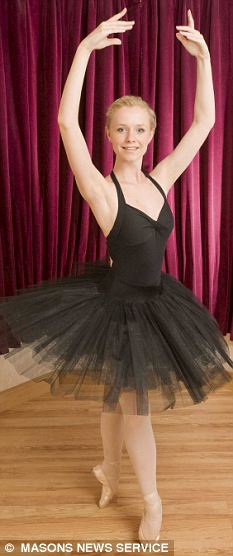
Now 16-year-old Natalie Carter can be added to that illustrious list after beating thousands of hopefuls from around the world to win a place at the prestigious ballet school in Moscow.
Later this month she will become the fourth British girl to enter the academy in its 230-year history, after she was spotted by a talent scout.
She was seen by a former Bolshoi dancer who asked her to send a ten-minute audition tape to the historic ballet school.
Natalie, who collects her GCSE results on Thursday, had already won a place at the Central School of Ballet in London, but said she was amazed when she was accepted by the Bolshoi.
She said: 'When I first found out I was scared but very excited. I have always liked to dance and I love ballet.
'It is one of the best opportunities ever given to me to fulfil my dream of becoming a professional ballerina one day.'
When she arrives in Moscow on August 30, Natalie will face a gruelling 40 hours a week of intensive ballet classes before she is deemed ready for the academy's normal regime.
She will also have to study Russian for an hour-and-a-half every day, as all the dance classes are taught in Russian.
Natalie, of Watford, Hertfordshire, began dancing when she was seven and only began learning ballet when she nine.
She currently has 10 to 15 hours of dance classes every week, but students at the Bolshoi Academy train for up to ten hours a day.
But Natalie said she would accept the gruelling regime, saying: 'I find dancing very relaxing and it is good for expressing what you're feeling inside.
'It's very emotional and there is nothing like the feeling you get when you're dancing in front of an audience.'
Meanwhile her mother Sue, a legal secretary, has been faced with the equally daunting task of raising sponsorship to fund Natalie's Bolshoi dream.
The 44-year-old approached 1,500 local businesses to raise funds to pay the Bolshoi's fees of £956 per term.
The divorcee, whose younger daughter Sophie, 15, is also a keen dancer, said: 'It is an opportunity of a lifetime that very few have been invited to do.
'I am obviously very proud of both my girls, but felt totally and utterly sick at the prospect of my one of my baby girls going to study so young so far away.
'Natalie was always an entertainer, even before she started ballet she did drama, tap and modern and she always outshone the other children in performances. Other parents always came up to me and said she had an exceptional talent.'
Natalie was spotted by Svetlana Adyrkhaeva, a former principal dancer with the Bolshoi, when the Russian visited her dance school last September.
School principal Gypsy Booth said: 'We will be sad to see Natalie go, but obviously this is a good opportunity for her, though it is a big step for any 16-year-old.'
Source
Get a load of Napa, take the Wine Train
Susan Fornoff, Chronicle Travel Editor
Sunday, August 23, 2009

There was plenty of pooh-poohing when the Napa Valley Wine Train started choo-chooing 20 years ago from Napa to St. Helena twice a day. Locals fretted about the noise, the smoke and the general kitschiness of the little train that would wine and dine tourists.
The locals have stopped their grumbling as the tourists have rolled the turnstiles along. But is it all about the tourists? Is it possible that wine-savvy Northern Californians might want to climb aboard in this year of the stay-at-home vacation?
The answer from this Northern California passenger is an unqualified yes - and if you go, I'm betting the next time you send your visitors for a ride, you'll want to join them. I took the train twice to research this story - and then took my vacationing parents aboard for a Vintners Lunch with Vino D'Angelo. Our leisurely afternoon, which included a chat with the winemaker, was the highlight of their weeklong visit.
Getting there
It's an easy jaunt to downtown Napa and signs point the way to the train, at 1275 McKinstry St., just off Soscol Avenue. Lot parking is free and plentiful, and if you're early, there are some charming vendors in the station, including a wine shop well stocked with famous and lesser-known labels selected by Ryan Graham, the train's wine director.
The hardest part of the whole experience is selecting your itinerary when you make your reservations.
It's not as simple as selecting a departure time - those rarely vary, boarding at 11 a.m. for the daily lunches and 6 p.m. for the dinners. Within every ride, there are various itineraries, priced accordingly - ranging from the sumptuous winemaker dinner that might be going on in the Vista Dome ($154 per person with five courses and four full glasses of wine) down to the a la carte lunchtime or dinnertime seat in the un-air-conditioned Silverado Car ($49.50 just for the ride).
You don't have to eat to ride the train. You don't have to drink. I do recommend both highly.
Fine day aboard Wine Train
10:30 a.m.: Check in and find a couch for the entertaining orientation and tasting given by whomever will be manning, or womaning, the tasting bar on board. If you've heard it before, check out the cool gifts for vinophiles in the wine shop.
11 a.m.: Listen for your boarding call. Get your picture taken - there's no obligation, and you can see the framed result when you return to the station. Settle in at your reserved table, preferably in the Vista Dome - twosomes may be seated with other couples, and it's worth noting when you make your reservation whether you would enjoy this or would rather not - and get ready to enjoy the vineyards roll by at a comfortable 18 mph.
11:30 a.m.: As the journey begins, enjoy your glass of bubbly in the Vista Dome along with some not-so-scenic views of Napa, and then suddenly the hills come alive. Now is a good time to ask your server when you should get up and walk about the train. One can view the kitchen and find out how on earth they roll out food of such quality for so many in such a short period of time (and small space). And pours at the tasting bar come at a hefty four for $10, thankfully from a wine educator conversant in the 50 or so choices that may be on the shelves on a given ride.
It's also fun to go all the way up front and check out the locomotive running the whole show.

Noon: The food and its presentation will impress you, first because who expects decent food on a train, and second because there has been a concerted effort to match the cuisine to both the wine options and the train prices. You'll have choices to make for every course (four if you're riding in the Vista Dome, three if you're doing the gourmet service), including options suitable for vegetarians, and either follow the suggested wine pairings or make your own. My favorites were a California Dungeness Crab 3 Ways paired with Whetstone Viognier on a winemaker dinner with Jamey Whetstone, and the Rock Shrimp Sweet Pea Fritter with Curry and Ginger served with Vino D'Angelo Sauvignon Blanc on lunch with the folks.
1 p.m.: If you're not in the Vista Dome, you will be changing seats for dessert or for your entree, depending on whether you booked the early lunch or later lunch. If you booked the Ambassador Winery Tour, you are going to change cars for dessert. A nice touch: Most guests are seated on the opposite side of the train from where they were previously, so the views are fresh.
2 p.m.: If you've booked a winery option, you're going to hop off the train at a winery for a special private tour and tasting in a small group. On some of these programs, you'll visit two wineries. This can make for a long day but a great option for those who want a deeper Napa Valley wine experience.
2:15 p.m.: You're going to get a bill for your wine and any beverages you ordered other than coffee and tea. Here's one of the things I didn't like about the train: The service is fabulous, but the price of the ticket doesn't include a tip. And apparently the 12 percent service charge added to the beverage bill isn't considered a tip. Rule of thumb I have invented: Subtract $50 from the price of your ticket (the cost of the basic ride) and tip your server based on the remainder plus whatever you spent on beverages.
2:30 p.m.: Suddenly the train is returning to the station. Here's your chance to shop for some of the wines you've tasted.
4:30 p.m.: If you took the Ambassador Winery Tour, you're stumbling off the bus about now - hopefully to a comfy bed just across the street. You can always shop for your wines tomorrow.
Heading home
The staff clearly is well schooled in making sure the patrons aren't rolling off the train into the driver's seat of a car. But anyone attending one of the winemaker events ought to have a designated driver or, even better, a room at a neighboring hotel. I tried both the River Terrace Inn and the luxurious Westin Verasa next door and recommend either, depending on your budget. They are both across the street from the station in Napa.
Check out the shops and restaurants in and around the Oxbow Market just a few blocks away before chugging back to reality.
If you go
Remember that a dinner ride in the winter will not offer much in the way of views; this time of year, however, the ride up to St. Helena is stunning at sunset. Book your trip well in advance if you're heading up for harvest. Visit www.winetrain.com or call (800) 427-4124 for more information.
Stay
River Terrace Inn: A package for a wine train lunch for two and overnight accommodations starts at $389. 1600 Soscol Ave. (707) 320-9000, www.riverterraceinn.com.
Westin Verasa: Discovery wine train packages start at $467. 1314 McKinstry St. (866) 716-8126, www.specialoffers.starwoodhotels.com.
Eat
Your other meal of the day had best be a light one if you are dining off chef Kelly Macdonald's multicourse menus. Consider lunching off the short menu at the Hog Island Oyster Co. in the nearby Oxbow Market, (707) 251-8113, hogislandoysters.com. Or dine on pizza at Filippi's Pizza Grotto, (707) 254-9700, www.realcheesepizz.com.
Good to know
If you choose the Vintners Lunch or Winemaker Dinner and bring along your kids (not recommended for such a grown-up dining experience, though some will bring them anyway) or a designated driver, the nondrinkers have to pay full price. However, the drinkers can have their pours.
A new option for riders is the no-drive service available from San Francisco via ferry to Vallejo and shuttle to the train - a great deal, for the price of the ferry ticket plus $15 for the round-trip shuttle.
Source
S.F.'s (new) Palace Hotel celebrates a century
Carl Nolte, Chronicle Staff Writer
Saturday, August 22, 2009

San Francisco has a ton of famous old hotels - the Fairmont, the St. Francis, the Mark Hopkins - along with some grand new ones - the St. Regis, the Ritz-Carlton, the W. But the grande dame of them all is the Palace Hotel, which is celebrating the 100th anniversary of its rebirth this year.
"The Palace," said Robert Chandler, the Wells Fargo Bank's official historian, "is still old San Francisco."
There has been a Palace Hotel at the corner of New Montgomery and Market Streets for 134 years. The earlier Palace, a magnificent 800-room showpiece, was the largest hotel in the West - some say the world - when it opened in 1875 at the high point of the city's champagne and bonanza days. When it was destroyed in the great fire that followed the 1906 earthquake, the Palace became the symbol of what the writer Will Irwin called "the city that was."
The "new" Palace Hotel opened three years later, and marked the recovery of the city from the ruins of disaster.
"Lovers of San Francisco, the Palace Hotel has risen again," said Mayor Edward Robeson Taylor on opening night in 1909. "We could scarcely think of San Francisco without the Palace Hotel."
Lunch for $19.09
The actual anniversary of the new Palace is Dec. 15, but the management is staging a centennial celebration nearly five months long, beginning with special events, including hotel tours, which include a $19.09 lunch, on Tuesdays, Thursdays and Saturdays.
One reason for the long celebration is to attract attention. Like other San Francisco businesses, the Palace has been affected by the economic downturn, and the management freely admits that business is slow.
The hotel is also throwing an invitation-only celebration featuring Champagne, Palace punch and a 10-tier cake on Thursday. The hotel offered free tickets on its Web site earlier this month, but they were snapped up in two days.
It's hard to say what makes the Palace special in a city renowned for its specialness, but the hotel works hard to maintain an old-world panache.
Debs and martinis
The lobby floors are marble, the doorknobs on the 525 rooms are solid brass and the display cases in the lobby show off century-old gold table service. The famous Garden Court, which has Austrian crystal chandeliers, Italian marble columns, potted palms set under a huge stained glass dome is an official city landmark and an unofficial representation of what San Franciscans think of as high style.
The Palace is where debutantes, dressed all in white, would make their formal bow before the doyennes of San Francisco high society at the annual Cotillion; it is where suave young men would take their dates for martinis at Maxfield's bar under the gaze of Maxfield Parish's huge painting of the Pied Piper of Hamlin; the Garden Court is where San Franciscans would take visiting relatives for afternoon tea.
It has a ton of tradition. In the winter of 1950, Gaildo Pazini and his new wife, Patricia, who were married out in the Excelsior district, began their honeymoon at the Palace. The groom saved his money and spent $10.50 for an unforgettable night there. He still has the receipt.
Two years ago - 57 years, five children, seven grandchildren and two great-grandchildren later - he and his wife came back to the Palace for a party at the Garden Court.
"It's a grand hotel," he said.
There is a lot of history in the hotel, some of it a bit grim. Kings and at least one emperor, Dom Pedro of Brazil, stayed at the old Palace. David Kalakaua, the last king of Hawaii, died at the Palace in 1891.
Warren G. Harding was the last American president to stay at the Palace Hotel; he died there on Aug. 2, 1923. Several other presidents have made appearances at the hotel since Harding died, but none stayed the night.
The Palace was often the scene of civic receptions honoring the dignitaries of the day: Marshal Ferdinand Foch of France, Charles Lindbergh, the king of Belgium, Madame Chiang Kai-shek. In 1951, President Harry Truman and Soviet foreign minister Andre Gromyko came to a cocktail party where guests drank 1,700 glasses of bourbon, 1,500 glasses of Scotch and 12 gallons of martinis. The hotel kept track.
The Palace was owned for nearly 8o years by the family of William Sharon, one of the so-called Silver Kings who made a fortune in the fabulously rich mines of Nevada. In 1954, the family sold it to the Sheraton Corp. for $6.5 million.
The old barber shop with 20 fulltime barbers and seven manicurists was already history, but the new management changed the name to the Sheraton-Palace, standardized the rooms and cut some frills - like oysters Kirkpatrick from the dinner menu.
"It was no longer possible to maintain some of the costly traditions that sentiment once dictated," the new owners said.
Sit-in in the '60s
The '60s were a time of turmoil in San Francisco. The Palace Hotel was not exempt. In 1964, a famous sit-in took place in the Sheraton-Palace lobby to force the hotel to hire more minorities, particularly African Americans. Dozens of people were arrested.
In 1973, the hotel was acquired by the Kyo-ya Corp., a Japanese firm that owns most of the big hotels in Hawaii. Sheraton continues to manage the place.
By 1989, the hotel was showing its age. It shut down for more than two years and reopened in the spring of 1991. The renovation cost $150 million and won a number of awards for historic preservation. It also became known again as simply the Palace.
"I'm amazed that they kept it so well," said Pazini, who remembers the old days. "It looks as if they built it yesterday."
Palace Hotel
533: Number of rooms.
3: Number of restaurants.
1: Number of indoor swimming pools.
53,000: Number of square feet of meeting space.
888: Room number for the hotel's top accommodation: the Presidential Suite, which includes two bathrooms, a kitchen, a card room, a dining room and a bedroom.
2,900: Number of dollars it takes to stay in the Presidential Suite per night.
Hotel tours
When: 10 a.m. Tuesdays and Saturdays; 12:30 p.m. Thursdays.
Hosted: By San Francisco City Guides.
Price: $19.09 including lunch.
Reservations: (415) 546-5089.
E-mail Carl Nolte at cnolte@sfchronicle.com.
Source
Miracle Fruit Turns Sour Into Sweet

The miracle fruit, or miracle berry plant (Synsepalum dulcificum), produces berries that, when eaten, cause sour foods (such as lemons and limes) subsequently consumed to taste sweet.
The berry, which contains active polyphenols, The berry itself has a low sugar content and a mildly sweet tang.
It contains an active glycoprotein molecule, with some trailing carbohydrate chains, called miraculin.
When the fleshy part of the fruit is eaten, this molecule binds to the tongue's taste buds, causing sour foods to taste sweet.
While the exact cause for this change is unknown, one hypothesis is that the effect may be caused if miraculin works by distorting the shape of sweetness receptors "so that they become responsive to acids, instead of sugar and other sweet things". This effect lasts 15-60 minutes.
Source
Why she's giving away $50 million
By Steve Lopez
August 21, 2009
Melanie Lundquist of Palos Verdes Estates is optimistic that writing a $5-million check every year for 10 years to help low-performing L.A. schools will result in wider reforms nationally.
Imagine all the things you could buy if you had a spare $50 million under the mattress.
A yacht. A jet. A nice little getaway in Hawaii, and why not in New York, Rome and Paris as well?
A Palos Verdes Estates woman named Melanie Lundquist happened to have the extra $50 million, but she bought none of the above.
Instead, she called Los Angeles Mayor Antonio Villaraigosa in 2007 and told him she wanted to give the money to some of the lowest-performing schools in Los Angeles Unified. She promised to write a $5-million check each of the next 10 years for his Partnership for Los Angeles Schools, which took control of 10 campuses a year ago as part of the mayor's boast that he could do better than the district.
But those improvements are easier to promise than to produce, as this week's release of standardized test scores revealed, with the results a mixed bag of modest gains and just as many disappointments. Several weeks ago I wrote a column about teachers at eight of the 10 schools giving the partnership a "no-confidence" vote. They said they didn't have the decision-making power they were promised and that essentially, one bureaucracy had supplanted another.
At the time, I wondered how Lundquist was feeling about her investment. Give her a call, suggested Marshall Tuck, chief executive of the mayor's partnership.
And so I did.
I don't know if she's upbeat by nature, but Lundquist might as well have had pom poms the day we met at the Farmer's Market for lunch. She knew this would take time, she said, and neither the skepticism of teachers nor the lackluster test scores have given her pause.
"I believe this will become a model for national reform," said Lundquist, whose husband, Richard, owns a real estate development company whose holdings include the Intercontinental Hotel in San Francisco and numerous commercial buildings across Southern California.
So what exactly was the reason for a gift to schools that many have written off as irreparably broken?
"I went to public schools K through 12," said Lundquist, who went to Grant. Her husband also attended public schools in Los Angeles. "I got a free education, and there are 50 teachers I could name right now who were some of my best friends, and even after I graduated, they continued to be friends.
"I had a science teacher in 10th, 11th and 12th who would stay until 6 o'clock, working in the lab, and then drive all of us home. I've always regarded a good education as a foundation, without which you're marginalized and locked out of the economy."
And far too many kids, she said, simply don't have access to schools as good as the ones she attended.
Lundquist graduated from USC as a speech pathologist, but after marrying Richard, she decided to turn to philanthropy, inspired by Wallis Annenberg, among others. While waiting for a doctor's appointment one day, Lundquist read a Vanity Fair article titled "Rebel With a Purse," about New York City philanthropist Irene Diamond, and she became determined to support good causes.
Which ones?
Lots of them, and the Lundquists send fat checks here and there each year. But Melanie found her true passion after seeing Villaraigosa in 2005 at a political event and asking him what he'd focus on if he became mayor.
"He said 'education.' I said, 'Really, well if you decide to run for mayor, call me.' Twenty-four hours later, he called."
Yep, that sounds like our mayor. The Lundquists donated to his successful campaign and later to the school board members sponsored by Villaraigosa, who put her in touch with Tuck and Ray Cortines, the current superintendent, who was working for the mayor at the time.
They met on Feb. 9, 2007, Lundquist's birthday, and her present was to be swept up by their ambition and high hopes for better schools. In July, the partnership was launched. In September, the Lundquists made their pledge.
"It was incredible," Tuck said. "They're good human beings, but this was on a scale that was unheard of."
n total, the partnership has raised $65 million, with a scattering of donations in the $1-million range, but nothing approaching the Lundquist pledge.
I asked Richard how they arrived at $50 million. Did Melanie open the bidding at $100 million and he countered with $1 million?
He laughed and said no. The only indecision on their part was whether to give $25 million over five years or $50 million over 10 years, and that was quickly resolved.
But they didn't want to just sign checks and drop them in the mail. They wanted to be personally involved, and their division of labor went something like this:
Melanie would be the hands-on Lundquist, attending strategy sessions, visiting schools, getting to know principals, teachers and students.
"And Richard's job is to earn the $50 million," she said.
Melanie all but became a member of the partnership team, said Tuck, yet she hasn't been the least bit intrusive about how her gift is spent, other than to say she wants the partnership to be accountable for increasing student achievement. In the years to come, the Lundquist gift will pay for partnership staff, teacher development, campus improvements and more.
Melanie Lundquist said she got a quick education on campus conditions that were shocking and embarrassing. One school, in particular, was crumbling and filthy, the bathrooms in disrepair for years and some of them even locked. A team came in and steam-cleaned, fixed everything and painted. She said the principal, teachers and parents were so appreciative, some were in tears.
Lundquist said the goal is to break the schools into small and more manageable learning communities, to engage parents and merchants and future employers, and to have teachers more involved with each other and with administrators. Many of the teachers' critiques were well-founded, she said, and the partnership has to do a better job of clarifying their role in a transformation that she hopes will inspire other schools in the district and other districts in the country.
That's such a high bar, you wonder if Lundquist is setting herself up for a $50-million disappointment. Among other challenges -- such as disengaged students and parents, and inflexibility on the part of some districts and teacher unions -- there aren't a lot of people anywhere in the country who are willing to put up vast sums of money for the kinds of extras the partnership schools will enjoy.
"I'll bet you 25 cents that she's not disappointed," Tuck said.
We raised the ante to 50 cents, but the bet is off because like Tuck, I'd like for Lundquist to get some good returns on her stunningly generous investment and moral commitment.
"We've shortchanged kids, and we've shortchanged teachers," said Lundquist, but now there's a reform movement underway from Washington, D.C., to living rooms in the San Fernando Valley, where parents are rising up and demanding better results and more accountability. There's finally a chance, she said, to make a difference.
"Seventy-five percent of the inmates in California prisons are high school dropouts," Lundquist said. "That's crazy. People don't want to pay taxes, but we're paying for the prisons, and it's less expensive to educate people than to incarcerate them."
I asked Lundquist if she has friends who questioned the $50-million gift. Yes, she said.
"They say I'm wasting my time and money. They say it's socioeconomic."
When you know the kids and see their potential, Lundquist said, you understand both the challenge and the hope. She said she has been inspired by many students, and has begun referring to partnership youngsters as her scholars.
"It's the greatest thrill in the world to give your money away while you're still alive," Lundquist said.
At the 10 schools, 18,000 students stand to benefit from her investment in their future, but she figures she's got the better end of the deal.
"I'm the one who's lucky to be a part of this."
Source